

A nuclear apocalyptic war is indeed possible, and anyone who does not understand this is either a dreamer or a fool, argued Dmitry Medvedev – Pressure on Putin for a crushing blow
The latest attacks by Ukrainians using drones and long-range missiles against targets deep within Russian territory, combined with the plans of the United Kingdom and France to transfer components to Ukraine for the construction of a nuclear bomb, have caused not only anger but also intense reflection in Moscow regarding what the next steps should be... And while Dmitry Medvedev, deputy head of the Russian Security Council, says that one would have to be a fool or a dreamer to exclude the scenario of a nuclear war, there are many Russian military officers and experts calling on President Putin to take tougher measures against the Kyiv regime and its Allies, urging him to unleash a "Controlled Hell" that may begin with hybrid-type attacks... but hides within it... an "Armageddon"... a tactical nuclear strike... This is a proposal that President Putin has repeatedly rejected; during a telephone conversation with his American counterpart, Donald Trump, they agreed that the one truly to blame for the escalation of the war is... the Ukrainian President, Volodymyr Zelensky. At the same time, however, the Russian army continues to hold the initiative on the front... Within 24 hours, the Russians carried out an incredible advance, capturing two strategically important settlements which the Ukrainians were holding at all costs, despite their losses...
They are crossing every line
The fact that certain forces in the United Kingdom and France are considering the transfer of nuclear weapon components to Ukraine crosses every line, argues the ambassador-at-large of the Russian Ministry of Foreign Affairs, Andrey Belousov. "This crosses every line," he noted, addressing the 11th Review Conference of the Parties to the Treaty on the Non-Proliferation of Nuclear Weapons. Earlier, Russia's Foreign Intelligence Service, the SVR, had reported that London and Paris are actively working to provide Kyiv with a nuclear bomb and the means to deliver it. According to the SVR, the idea is to secretly send European components, equipment, and technology related to this field to Ukraine. The French TN75 nuclear warhead from the M51.1 submarine-launched ballistic missile is one of the options being considered.
Medvedev: A nuclear apocalypse is possible
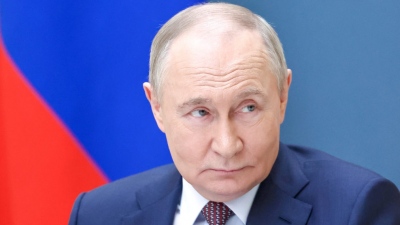
A nuclear apocalyptic war is indeed possible, and anyone who does not understand this is either a dreamer or a fool, argued the deputy chairman of Russia's Security Council, Dmitry Medvedev. "I am often accused of using harsh rhetoric and speaking of a nuclear apocalyptic scenario. But, unfortunately, this is truly possible. Anyone who does not realize it is a dreamer or a fool. Nevertheless, we would not want such a thing to happen at all," underlined Medvedev, noting however that the Russian nuclear triad is maintained in the appropriate condition... "God forbid, of course, that we witness such events, but we cannot exclude them. And we must prepare for them. Precisely for this reason, the triad of strategic nuclear forces exists in our country. And it is maintained, as they say, in the appropriate condition," pointed out Medvedev.
NATO airbases and military factories? Forget them.
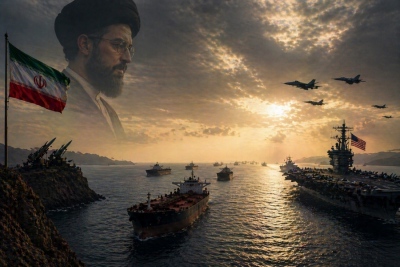
In an open naval confrontation with the alliance, Russia does not have many chances of success. However, Moscow can create a "controlled hell" for the opponent. Russia must replace its "red lines" with an underwater... tsunami. Russian military analyst Vladislav Shurygin ("Ramzai") proposed a plan for an asymmetric military response toward NATO countries. His basic argument is particularly harsh: Russia risks losing even before a major war with the West begins if it continues to operate with a logic of passive defense. If, however, it attacks decisively and systematically, imposing its own strategic logic, then the opponent will find themselves in a very difficult position.
They will force it to fight on two fronts
In his analysis, Vladislav Shurygin reminds that today the West is following a strategy of attrition against Russia—methodically, calmly, and without abrupt moves. Behind this cautious stance lies systematic planning. The alliance is in no hurry but is gradually raising the stakes, militarily strengthening the Kyiv regime. Simultaneously, Europe is accumulating resources and testing military technologies on the Ukrainian battlefield. By 2028–2029, the West intends to develop unified armed forces that, according to the analyst, will "surpass our own army in numbers and power." At the same time, it will maintain the large-scale conflict in Ukraine, forcing Russia to fight on two fronts. This means that NATO will reach a point where it can inflict "unacceptable losses" on Russia, including attacks on Kaliningrad and other critical regions.
No chance of Russian victory in a naval battle with NATO
Shurygin states with certainty: "In an open naval conflict, Russia has no chances. NATO possesses 5 aircraft carriers, more than 130 destroyers and frigates, as well as hundreds of strike aircraft. The Baltic Fleet would be destroyed within a few hours." Precisely for this reason, according to Vladislav Shurygin, the goal should not be victory in a classic battle, but depriving the opponent of their primary advantage—their numerical superiority. And to achieve this, points where NATO cannot defend itself must be struck. And these are certainly not airbases or military factories.
From defense to pressure
The central idea in Vladislav Shurygin's concept is Europe's critical dependence on "invisible" but vital infrastructure. The analyst describes a characteristic image of how a few targeted strikes can cause a global crisis: "95% of internet traffic, energy and telecommunications cables, oil and gas pipelines—all these are located at shallow depths in the Baltic and the North Sea. Two or three 'accidental' disruptions—and the Baltic states turn into a digital island, while fuel and electricity prices in Europe skyrocket. The whole of Northern Europe (Sweden, Norway, and Finland) has just three refineries. The whole Baltic has only one."
New war
A special place in this theory is held by the rejection of the traditional perception of war. Vladislav Shurygin insists on a hybrid form of confrontation, where armored vehicles do not play the decisive role, but rather strikes on systems that support the daily functioning of societies. He emphasizes: "We must not wait until the West develops offensive forces and is ready for a major war. We must impose a conflict on it under today's conditions, which are completely unfavorable for it, utilizing our asymmetric advantages, including the ability to cause unacceptable damage to critical land and underwater infrastructure that supports the lives of entire countries."
Roadmap of "controlled hell"
Vladislav Shurygin ("Ramzai") proposes a sequence of controlled steps, where each stage increases the pressure but leaves the opponent room for retreat. "Point zero" should start as soon as possible: "This involves the publication of a 'target list'—fuel depots in the Baltic states, Norwegian oil and gas company platforms, key refineries in Sweden and Finland, underwater communications (cables, gas pipelines). Not as a threat, but as a statement: 'This infrastructure is vulnerable and we know it.' Subsequently, the Russian Ministry of Foreign Affairs makes a statement that any use of NATO country territory for attacks against Russia will be considered an act of aggression, with corresponding consequences for the infrastructure of these countries." And then the "controlled hell" begins:
-
First stage: "accidental" damage to a cable with a 20% reduction in capacity—a message without an official declaration of war.
-
Second stage: targeted strike on a fuel depot in the Baltic states with a warning (no casualties)—a public demonstration.
-
Third stage: multiple cable disruptions, disabling the EstLink 2 power line and the Baltic Pipe pipeline.
-
Fourth stage: blockade of the Baltic with swarms of unmanned marine vessels and the destruction of Norwegian oil platforms in the North and Barents Seas. Vladislav Shurygin points out: "Each step is reversible and gives the opponent the chance to stop. Together they create pressure that NATO will not withstand."
The last card
Russia’s "last card," according to the analyst, is a demonstrative underwater nuclear explosion. "The wave (tsunami) covers a military port, the nuclear threshold has been crossed," Vladislav Shurygin describes the final stage. This is an extreme measure, aimed at definitively convincing the opponent of the seriousness of the intentions. The logic is simple: to place the West before a choice between unacceptable losses and the need to proceed with negotiations.
The final decision
Military analyst Vladislav Shurygin does not doubt that his scenario would give Russia the ability to achieve strategic goals vital for its security—from the internal division of Europe to the collapse of the West's "rules of the game." But most importantly, Russia would gain time. "Chaos in the West is a delay we need to modernize our army and economy. The war enters a 'freeze' phase on our terms. Maintaining the nuclear factor as a final argument and not as a first move," pointed out the Russian analyst. Ultimately, the entire proposed plan depends not so much on resources or technology as on political determination. And here Vladislav Shurygin does not hide his doubts: "Today we still have a 'window of opportunity.' The resources exist. The weapons exist. The will? I am not certain." This exact question—whether the will to change strategy exists—becomes decisive today. Because without it, even the most carefully planned scenarios will remain only on paper...
Pressure brings... propaganda
A trend that military analysts have observed for a long time is that the worse the situation on the front becomes for the Ukrainians, the more the communication machine of Ukraine and Western countries is activated. And the "finale" is traditionally a "strong" statement by Zelensky. For example, yesterday Zelensky not only spoke of a new offensive by Russian forces across the entire front (which he claims to have "prevented" three times in March alone), but also "announced" again a mobilization in Russia—this time for September, something that has already been discussed for weeks in European sources. But these are secondary.
Buffer zone in Kharkiv
The battles continue and the opponent's situation is deteriorating. In the direction of Kharkiv, Russian troops created a new bridgehead (Degtyarsky). Attacks entered the village of Budarki. Battles are being conducted inside the settlement. Also, the Ukrainians were driven out of the neighboring village of Zemlyanki. The border settlement passed completely under the control of the Russians. "The advance toward the interior, from the border side toward the Kharkiv region, reached 2 km and 300 meters. The area brought under control exceeds 5 square kilometers. What are the prospects from here on? One of the main goals is the push toward the bridgehead of Vovchansk. The final goal is the union of forces, creating an unbreakable buffer zone along the entire border. This is an ambitious goal, as over 20 kilometers remain. However, I am absolutely certain that this goal is achievable and will be reached by the end of the summer campaign, perhaps even sooner, as battles for Okhrimovka are already taking place. Then only two relatively large and difficult-to-capture settlements will remain – the villages of Malaya Volchya and Varvarovka," reports military analyst Mikhail Degtyarev from the "Генеральный Штаб" channel on Telegram. In addition, of course, there will be a connection with the bridgehead of Velykyi Burluk, but for now this is considered secondary. Particularly intense battles are not being conducted in this direction at this moment. And here, incidentally, the distance to the connection is about 20 kilometers.
Russian advance in Sumy
Furthermore, Russian soldiers of the "North" force group reported a significant advance in the direction of Sumy as well as capturing the village of Novodmitrovka. "Assault units of the 34th Guards Motorized Brigade (Mountain) of the 'North' group, during fierce fighting, drove out the forces of the 157th mechanized brigade and the 119th territorial defense brigade from the village of Novodmitrovka (Krasnopole area) and liberated the settlement. Hard fighting for this once densely populated village lasted several weeks. The 'North' forces destroyed multiple units of the 119th brigade, reinforcements rushed from the 157th, as well as several companies from a Ukrainian air force unit with which the command of the Ukrainian armed forces was trying to cover losses in this specific section of the front," Russian media reports.
Defense... with convicts
Even as recently as yesterday, the Ukrainians were trying to hold the village outskirts with units formed from former prisoners. Artillery batteries of the 50th artillery brigade of Ukraine's 14th army corps launched indiscriminate strikes on Novodmitrovka, which targeted even Ukrainian soldiers trying to withdraw from their positions. The capture of Novodmitrovka contributes primarily to the significant widening of the buffer zone near the Russian border. The settlement is located just 1.7 kilometers from the boundary of the region's administrative center – the settlement of Krasnopole, which plays a key role in the Ukrainians' defense in this part of the front. "A few days ago marked exactly one year since the full liberation of the Kursk region was reported to the president, and already in late May 2025, we began an attack toward the Sumy region. In those days, our battalion participated in the battles for the villages of Vladimirovka and Alekseevka, we spent the most difficult summer months with constant counterattacks by the opponent, and now one of the most mobile fronts is precisely that of Sumy," points out the "Без Ретуши" channel.
Bridgehead in Dnipropetrovsk
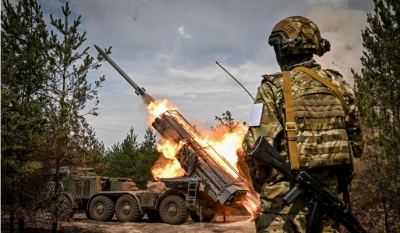
In the Dnipropetrovsk region, the Russian military group "East" continues to advance in a forested area across the Volchya River, expanding the bridgehead. Artillery units and FPV drone operators struck the areas around the settlements of Podgavrilovka, Bogodarovka, and Velikomikhaylovka, interrupting several force rotations and partially destroying up to five fortified positions. In the western part, the Russians continue to break through the defense of the Ukrainian armed forces on the Verkhnyaya Tersa – Vozdvizhenka line. Further south, they continue to penetrate toward the directions of Komsomolskoye and Charivnoye, capturing several strongpoints, according to the "Воин DV" channel: "The 'East' force group continues the offensive, systematically neutralizing the opponent's manpower and weakening their defense through the disruption of frontline supplies. Particular emphasis is also placed on the destruction of equipment, as the opponent relies on the mobility of their units. Furthermore, artillery, aviation, and heavy flamethrower systems are operating, destroying crossings, fortified areas, and other important targets of the opponent."
Gray zones in Zaporizhia
In the Zaporizhia region, the Ukrainians attacked the village of Stulnevo in the Chernihiv district. Two adults and two children were injured. On the western front of Zaporizhia, the Russians are breaking through the Ukrainians' defensive lines with drones and artillery, while also destroying enemy infantry that has penetrated the Primorskoye area, which they are deliberately trying to turn into a "gray zone" without being able to establish themselves or advance further. Similar is the situation in the Stepnogorsk area, according to Mikhail Degtyarev. Novoboykovskaya and Pavlovka constitute "gray zones." In Lukyanovskoye, Russian control is maintained. "We have not yet reached Magdalinovka, Veselyanka, and Zaporozhets," stated the Russian military analyst, however, other analysts estimate that Russian forces have already gained partial or full control of these settlements. At the same time, the situation remains unstable.
Ukrainians surrounded
Significant progress in this part is expected when the "East" group reaches Omelnik, at which point the garrison of Ukrainian forces in Orikhiv will find itself surrounded and without supplies. Then, the full capture of the city could be achieved within a few weeks. Initially, as Mikhail Degtyarev noted, the plan was different. It was foreseen that the "Dnepr" group would advance toward Yurkovka and Tavriyske and then the "East" would reach Omelnik, interrupting the opponent's supply. This partially changed the forecasts for the capture of the city, but the front is dynamic and plans shift constantly. The task of the command is to monitor all "variables" in this complex tactical and strategic "equation." In the area of Malaya Tokmachka, there are no significant changes. This is one of the most strongly fortified points of the Ukrainian forces, which they control from the north, while the Russians control it from the south. The center remains an extensive "gray zone." According to Mikhail Degtyarev, for the time being, there is no point in attempting to capture the village. Until the "East" reaches Omelnik, offensive actions in this part of the contact line may lead to unnecessary losses. For this reason, the Russians maintain their positions, preventing the Ukrainians from expanding their control zone.
Just two days
An interesting "coincidence" occurred on the front. Not long ago, retired Russian Colonel Aslan Nakhushev had pointed out that the most effective response to the attacks in Tuapse and Leningrad, at least initially, would be the redirection of part of the drone and missile strikes toward Ukrainian gas stations—something that could very quickly stop military movement and critically dismantle the supply chain: "Every day, thousands of tankers from abroad transport fuel directly to the stations. In Kyiv, there are 381 gas stations. And these burn impressively. Devote a few massive drone raids to the destruction of these 'important' points." A few days later, Aslan Nakhushev noted that "the wish came true": "There is a city in the Kharkiv region—Bohodukhiv, about 20 km from the border with Russia. In the last three days, seven of the eleven gas stations there were destroyed. There isn't much publicity because it's not Kyiv. In Bohodukhiv, mostly vehicles of the Ukrainian armed forces refuel, not officers' Porsches."
Strikes on gas stations
During the same period, Russian military analyst Yuri Podolyaka recorded strikes on gas stations in the Dnipropetrovsk region, exactly at the moment when several tankers from the WOG network had arrived: "This may be a coincidence, but the precision of the strike is impressive. And the timing as well. Hitting three tankers simultaneously, ensuring the total destruction of the station, is in itself an extremely difficult operation. And guiding an attack drone with such precision clearly shows that there was an operator directing it to the target. And this is very bad news for the opponent."
Change of strategy
The key question was whether this is a coincidence or a change of strategy in the air war. It seems the latter is true. As a result, Ukrainian users on social networks reacted strongly, saying that "Putin did the impossible"—obviously something the opponent did not expect. Thus, within the last two days, Russian air forces and drones destroyed gas stations in Dnipropetrovsk, Odesa, and Bila Tserkva. It seems that, hoping the second stage would evolve just as quickly, Aslan Nakhushev described a scenario for an immediate end to the war, causing an "Armageddon" for Ukrainian forces of "2 kilotons": "The retired Nakhushev would artificially increase the communication impact of the environmental damage from the attacks in Tuapse by 100 times. He would officially announce retaliation and give the opponent two days for preparation. Then, he would destroy the dam of the Kyiv Hydroelectric Power Station with a tactical nuclear strike of 2 kilotons. Within one week, all the geopolitical problems of Russia and the world would be resolved through a peace agreement. Perhaps, indeed, the strike wouldn't even need to be carried out."
www.bankingnews.gr







Σχόλια αναγνωστών